MOTHER OF SANTA BARBARA’S POLITICAL MATRIARCHY DIES AT AGE 97

EARLIER: SHEILA LODGE TAKES A VICTORY LAP

Sheila Lodge (from Pearl Chase with love)          

By LUIS MORENO | October 29, 1992

Presented at the Museum of Natural History performance of political humor, Calaveras, a Mexican Dia de los Muertes tradition, by the Santa Barbara Theater Co.

Dearly beloved
We are gathered in prayer
To pay last respects 
To Santa Barbara’s mayor.

Through thick and thin 
She paid her dues —
At ribbon cuttings 
and barbecues.

Most politically correct
Was Ms. Sheila Lodge
I believe she recycled
Out of her garage.

But she angered some motorists 
When she tried to close off State;
They weren’t going to be “malled.”
They would retaliate.

She tried to convince them
It would reduce air pollution,
But they considered this
A pedestrian solution.

So they took this matter
Into their own hands,
And organized squadrons
Of cars, trucks and vans.

As they descended upon her
She made gestures to talk.  
Then she was run down,
Caught in the crosswalk.

That familiar smiling face
That once graced our stage
Was now out of focus
On the News-Press front page.

The County Coroner declared
Right after the cremation
That Mayor Sheila Lodge succumbed
Due to poor circulation.

Sheila Lodge was a hero

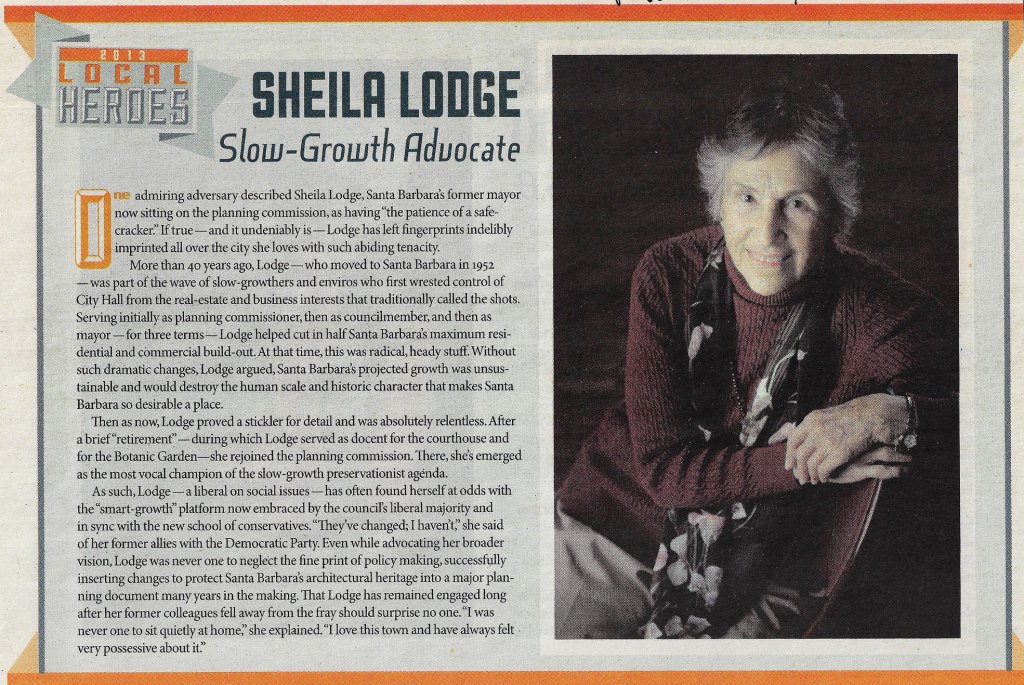
She was an Independent Local Hero in 2013 — 20 years after she was mayor.

By THOMAS REYNOLDS
for the Montecito Journal

Sheila Lodge, the first woman mayor of Santa Barbara and its longest-serving, died on July 8 at age 97. She probably always will be Santa Barbara’s longest-serving mayor, since term limits now restrict her successors to two terms.

She is less known all the way over in Montecito, which is not part of Santa Barbara — except for Coast Village Road, which was annexed for its sales tax revenue.

That had some advantages during her long political career — first as planning commissioner in the 1970s, then on the city council for six years, then as mayor for 12 years. Later she unretired and went back on the Planning Commission for another 16 years — and then, after retiring to get a new hip at 95, onto the Historic Landmarks Commission until the end of her life.

By then she herself had became a historic landmark, a sometimes lonely voice that for nearly a century after modern Santa Barbara was created after the 1925 earthquake kept reminding people how Santa Barbara had become such a special place: through careful planning that strictly limited growth to only what its natural resources could accommodate, and vigorous citizen involvement that made certain city leaders kept the faith. Also: that the earthquake wasn’t as devastating as it’s remembered, but merely cleared the way for Bernard and Irene Hoffmann to begin realizing their dream of a Santa Barbara that honored its Spanish and Mexican heritage with a cohesive architecture and the nation’s first Architectural Board of Review. “It wasn’t Pearl Lodge!” she insisted.

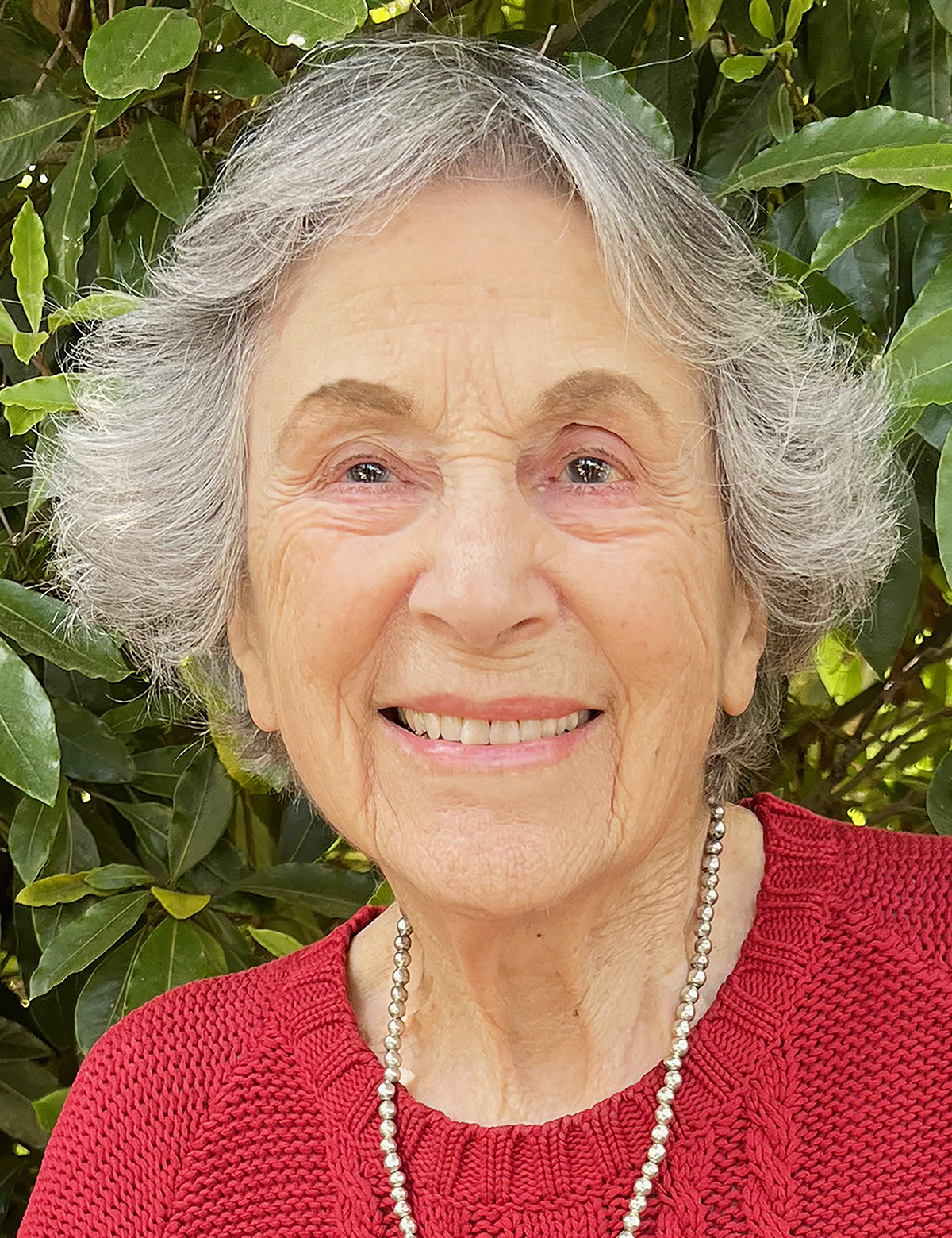
Sheila Lodge in 2025.

That Montecito was not part of Santa Barbara was something she frequently mentioned in her speeches when she was mayor. Contrary to popular myth, she maintained, Santa Barbara was not, in fact, a wealthy town. It was in the bottom half of California counties in per capita income. That was because Montecito and Hope Ranch weren’t actually part of Santa Barbara — and that’s where much of the big money was, and still is.

When she unretired again at 95 and went onto the Historic Landmarks Commission, she thought a new portrait was in order, even though she still looked pretty much as she had in the portrait used on the back cover of her book, Santa Barbara: An Uncommonplace American Town, locally published in 2020. Using an old photo wouldn’t be honest, she said.

Sheila Lodge died as she lived. When the pain in her new hip returned and became too much to bear, she called her doctor and told him, “I’m done here.” He ordered up the end-of-life medicine allowed under California law. She took it four days later, after all four of her daughters arrived.

The hospice nurse warned her it could take up to 18 hours to be fully effective, but that she would be peaceful and unaware. It took her almost 40 hours. She died on the morning of July 8, in the home she herself designed, atop Mission Ridge, with a view of the mountains and the shimmering blue channel surrounding the city she loved.

‘A pedestrian-first, park-like place’

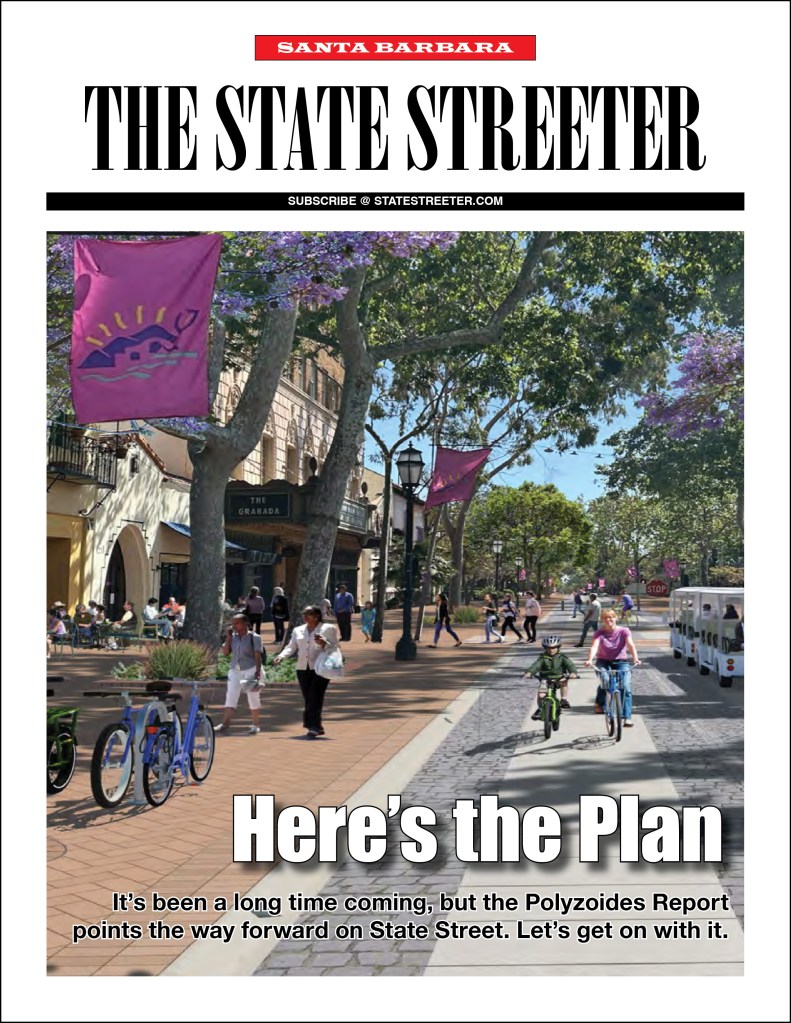
From the report:

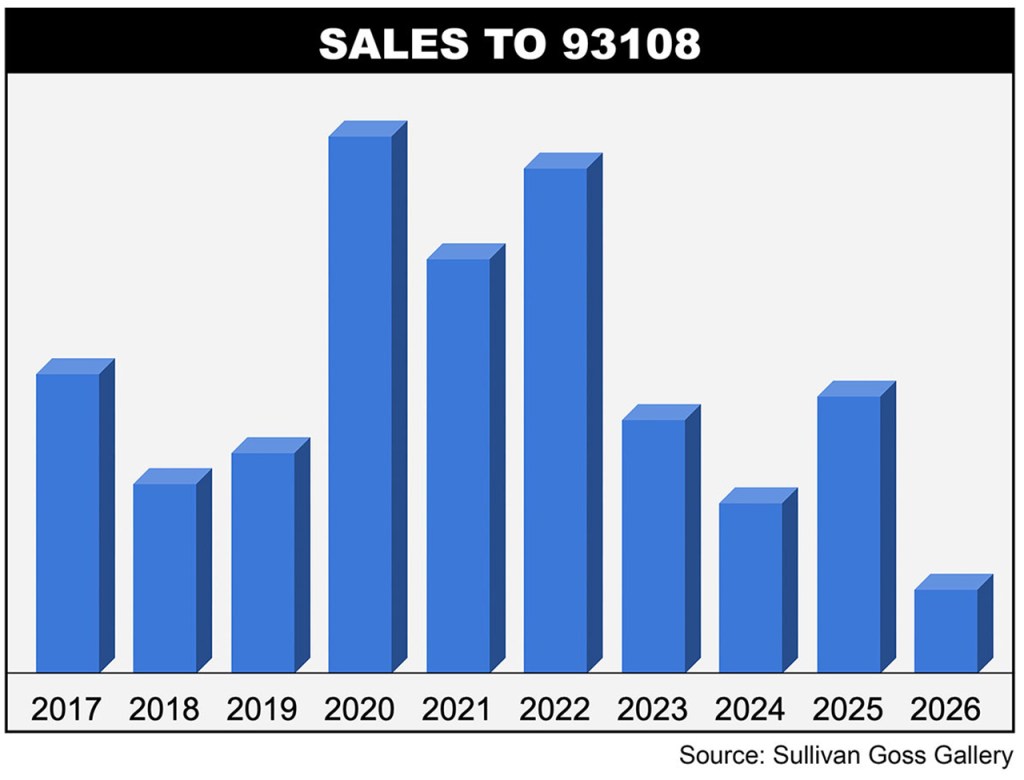
Before 2020, State Street was one of the premier retail venues in California, its unique form, reputation, and performance steadily increasing over time. Since 2020, several important national retail trends have conspired to reduce its expected evolution: the expansion of internet sales, the collapse of the department stores at Paseo Nuevo, and the erosion of its development potential due to uncertainty about its future. Yet, despite being subject to all these negative trends, its appearance remains poor and its current mix of modes chaotic; however, sales and tax receipts have plateaued, but not decreased.

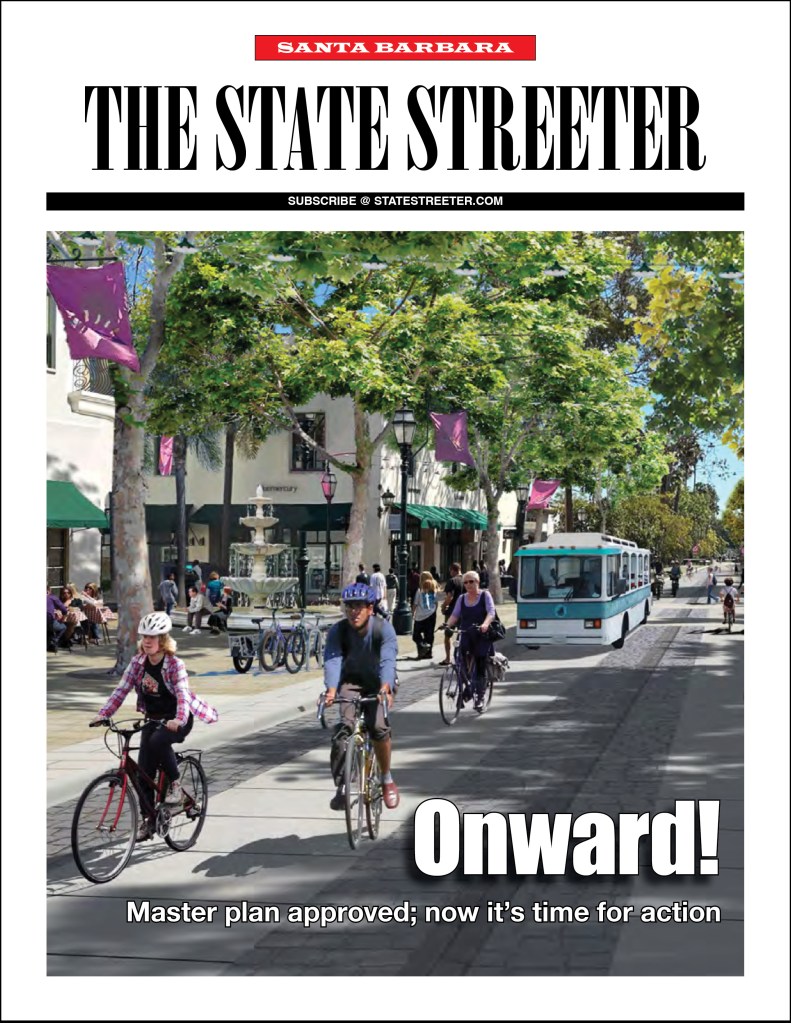
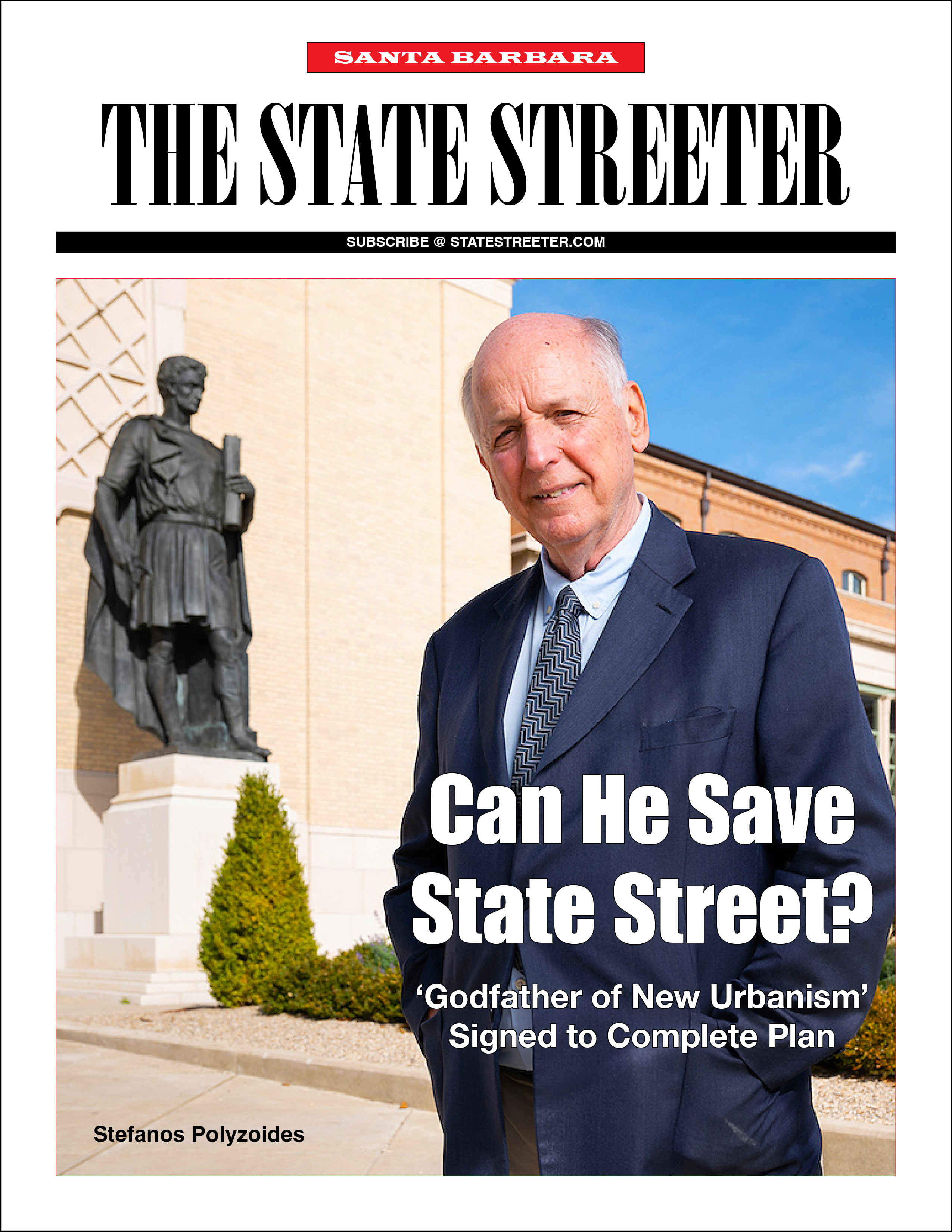
A flex scheme reorders the form of State Street according to its traditional 75-year pattern as a pedestrian-first, park-like place. It recognizes its subdistricts and takes advantage of the ample garage parking that serves them. It acknowledges mode mixes unique to the mobility needs of citizens and visitors alike. It proposes infra-structural and ecological improvements and offers recommendations for the many actions the city needs to take in support of the proposed changes. Continuing the traditional trajectory of this extraordinary place will strengthen its claim as the commercial center of your city. Its physical regeneration also stands a good chance of achieving the full range of social and financial objectives expressed by the citizens of Santa Barbara.

DRAFT STATE STREET MASTER PLAN
APPENDICES, INCLUDING THE MOULE & POLYZOIDES REPORT
SITELINE’S SUMMARY

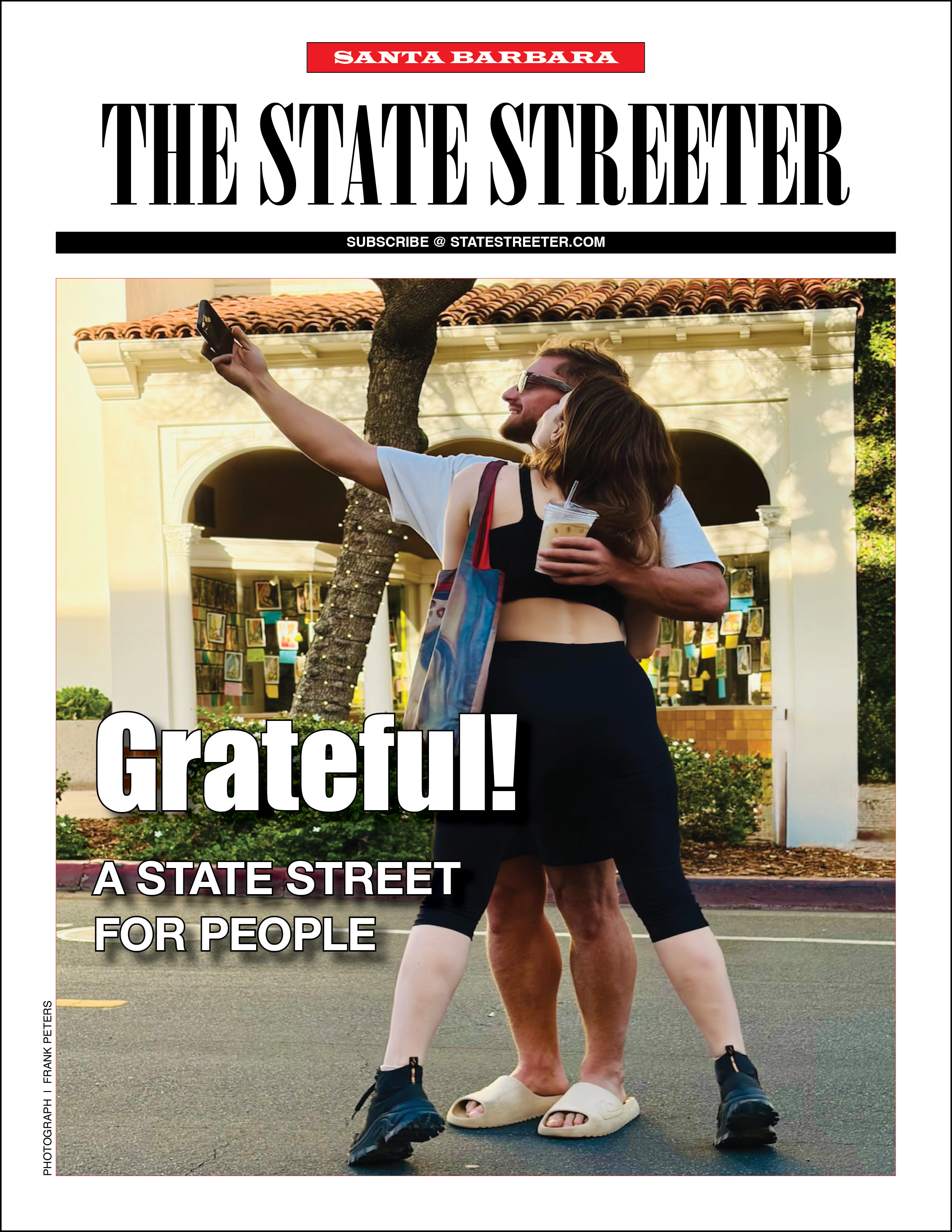
Labor Day on State Street

Photograph by Frank Peters

YOU’D NEVER KNOW it’s the end of summer. Toasty days and balmy nights are greeting visitors to Santa Barbara this Labor Day weekend — along with these cheery new umbrellas at Andersen’s.

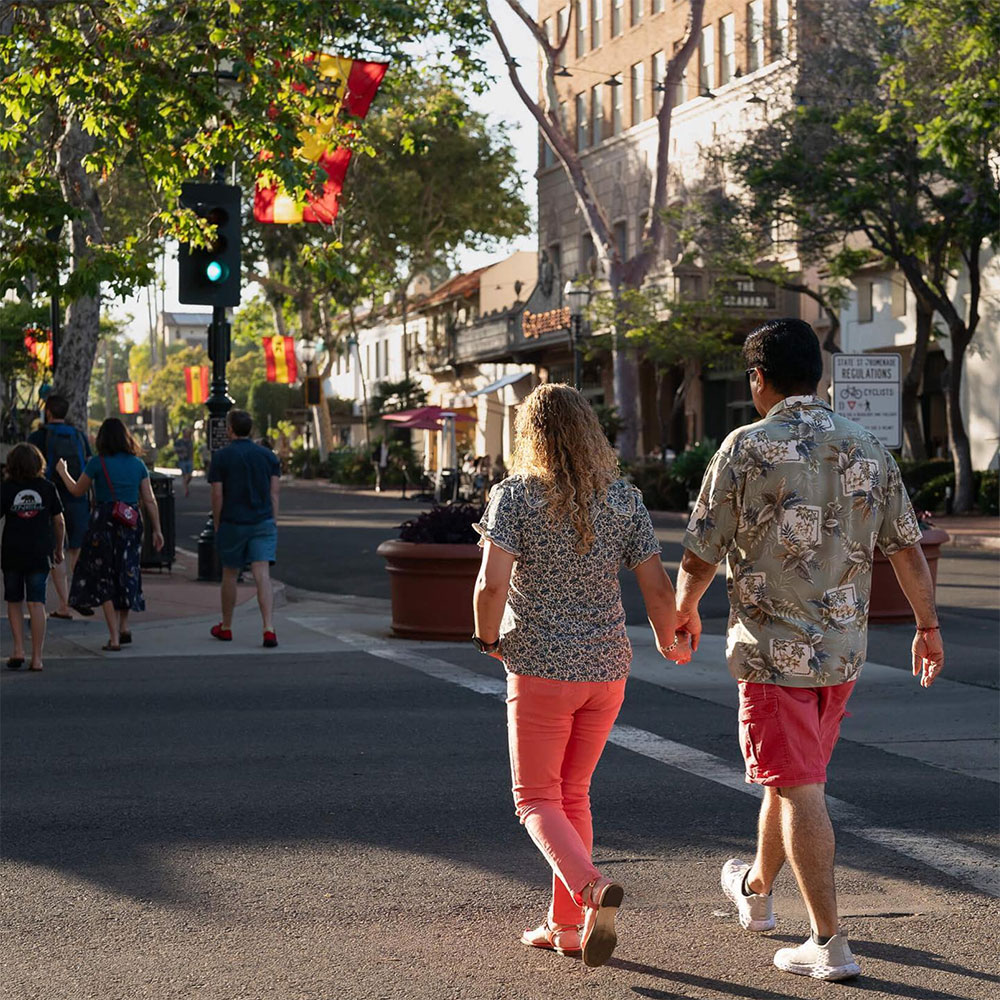
FIVE YEARS AGO, exactly, the State Street Promenade was born. It happened, seemingly overnight, in the early dark days of the pandemic. After weeks of staying home, people spilled out onto State Street that Memorial Day weekend, happy for human contact again, yet safely distanced in the sunshine and fresh air. We were alone, but together.

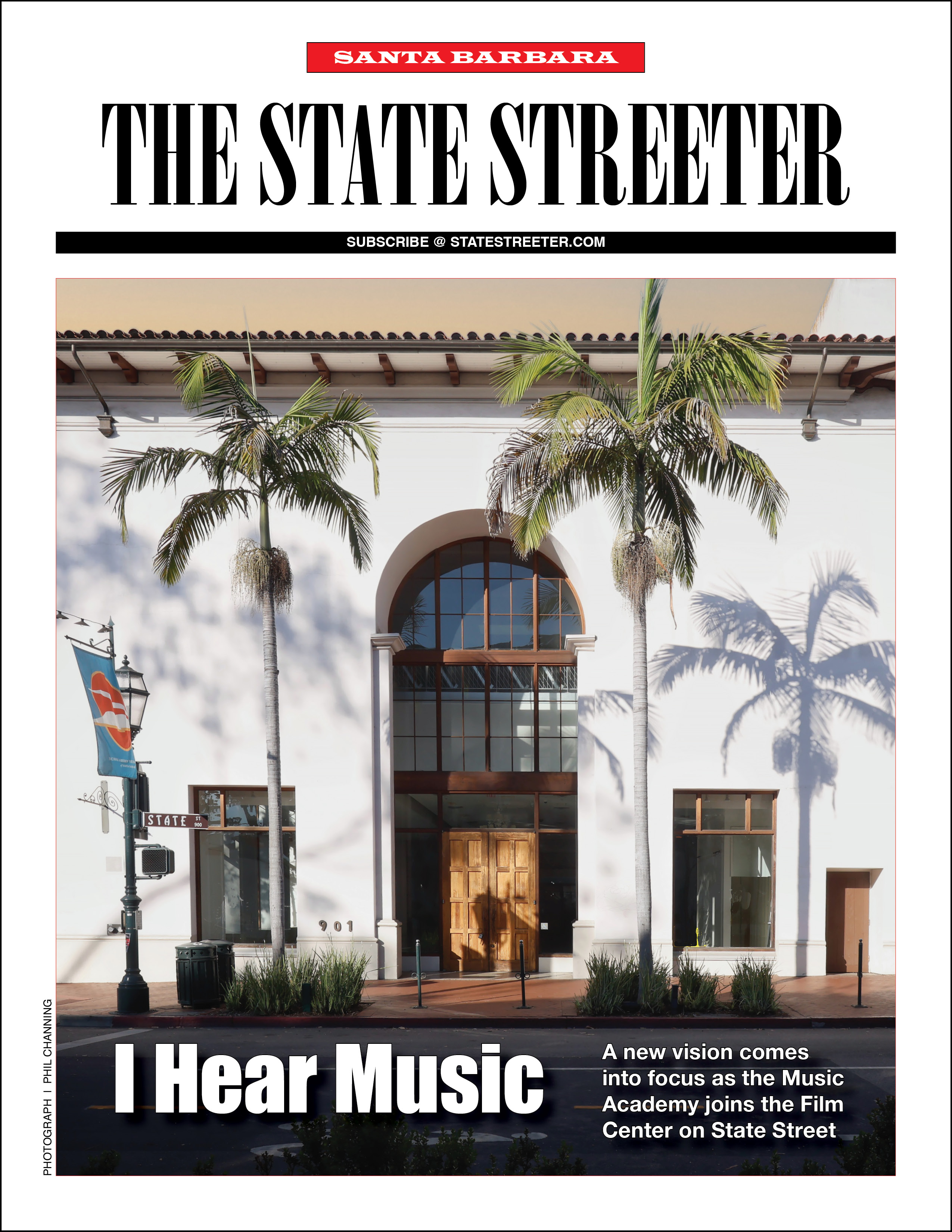
There are far more people on State Street now than there were in the years immediately preceding the pandemic. Moving the farmers market to the street has been a major boost, along with an expanded First Thursday art walk, a new film center and community-building special events sponsored by downtown civic and volunteer leaders. Yet the dream is still far from being fully realized. Getting locals back downtown, after decades of turning elsewhere, remains a key challenge.

Here’s hoping Santa Barbara’s beautiful and historic main street continues to move toward the future, not lurch backward — and that there will be much more to celebrate over the next five years.

Clippings

Paseo Estado: A downtown shopping area designed for the pedestrian.

There is a growing awareness that the automobile is getting out of hand; that its influence on the urban scene is becoming dictatorial rather than beneficent. It is the instrument whereby free rein was given to urban sprawl and, now that we have sprawled all over the landscape, it has become the indispensable element essential to holding the whole loosely knit package together. With the increase in population and prosperity, the automobile is demanding more and more land for its exclusive use.

In places like Los Angeles, it is demanding a lion’s share of the very air—polluting it and rendering it unfit to breathe. The quirk of nature that allows the automobile to steal the air in Los Angeles is called a “temperature inversion.” Santa Barbara has its own temperature inversion. All we need is a few more cars to attain the unhappy distinction of becoming more like Los Angeles.

— text and image from the 1964 General Plan for Santa Barbara

WHEN PARIS SAID AU REVOIR TO CARS, AIR POLLUTION DROPPED

Over the past 20 years, Paris has undergone a major physical transformation, trading automotive arteries for bike lanes, adding green spaces and eliminating 50,000 parking spaces. Part of the payoff has been invisible — in the air itself.

Airparif, an independent group that tracks air quality for France’s capital region, reported that levels of fine particulate matter have decreased 55 percent, while nitrogen dioxide levels have fallen 50 percent. [Washington Post]

“PURE JOY” — SAN FRANCISCO’S GREAT HIGHWAY BECOMES A PARK

Thousands of people turned out on a sunny Saturday to celebrate the opening of San Francisco’s newest park, the 2-mile stretch of the Great Highway now dubbed Sunset Dunes. Runners, bicyclists with kids in tow, friends with coffees in hand and children on scooters all convened on the stretch of highway now permanently closed to cars. [SF Chronicle]