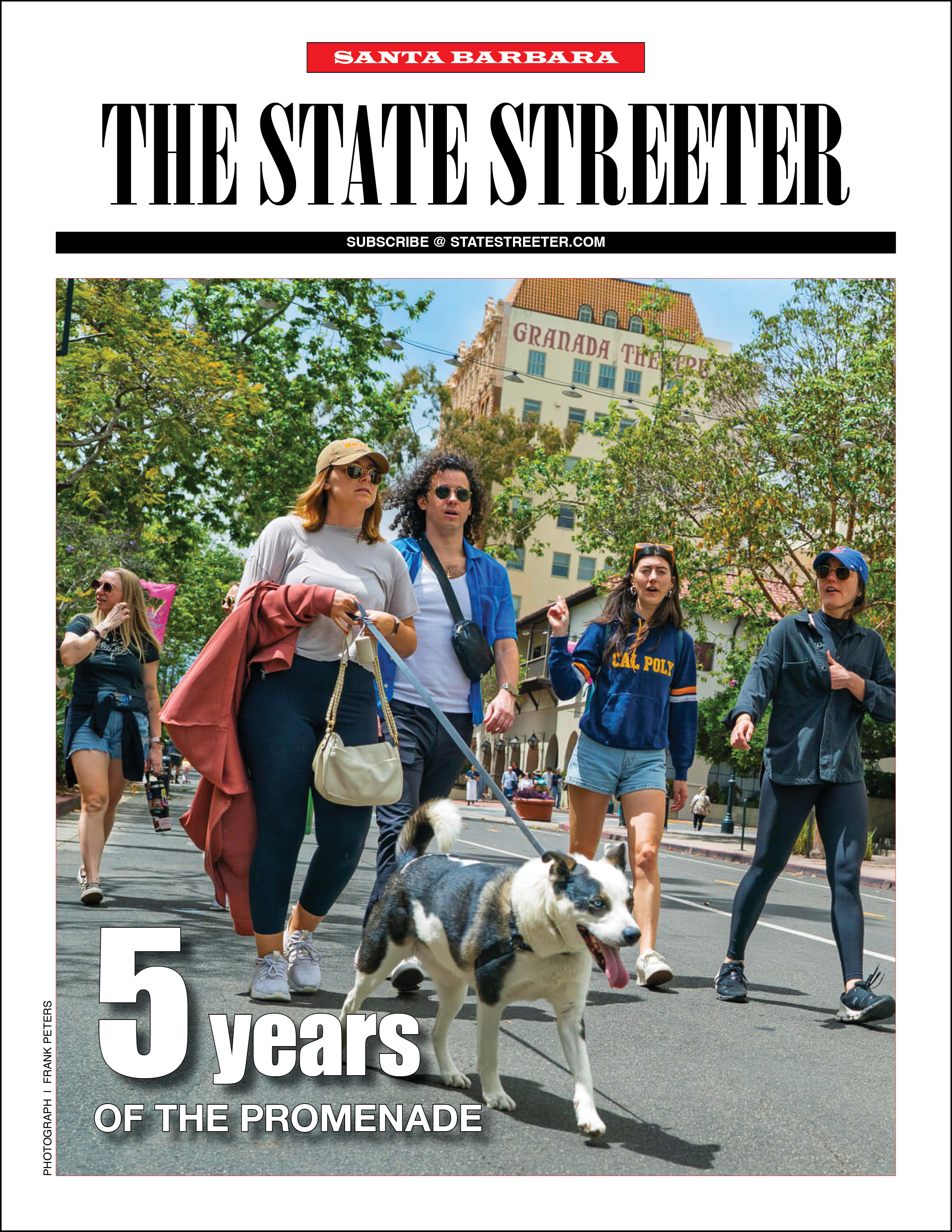
THE STATE STREET PROMENADE BEGAN ON MEMORIAL DAY WEEKEND 2020
FIVE YEARS AGO, exactly, the State Street Promenade was born. It happened, seemingly overnight, in the early dark days of the pandemic. After weeks of staying home, people spilled out onto State Street that Memorial Day weekend, happy for human contact again, yet safely distanced in the sunshine and fresh air. We were alone, but together.
There are far more people on State Street now than there were in the years immediately preceding the pandemic. Moving the farmers market to the street has been a major boost, along with an expanded First Thursday art walk, a new film center and community-building special events sponsored by downtown civic and volunteer leaders. Yet the dream is still far from being fully realized. Getting locals back downtown, after decades of turning elsewhere, remains a key challenge.
Here’s hoping Santa Barbara’s beautiful and historic main street continues to move toward the future, not lurch backward — and that there will be much more to celebrate over the next five years.
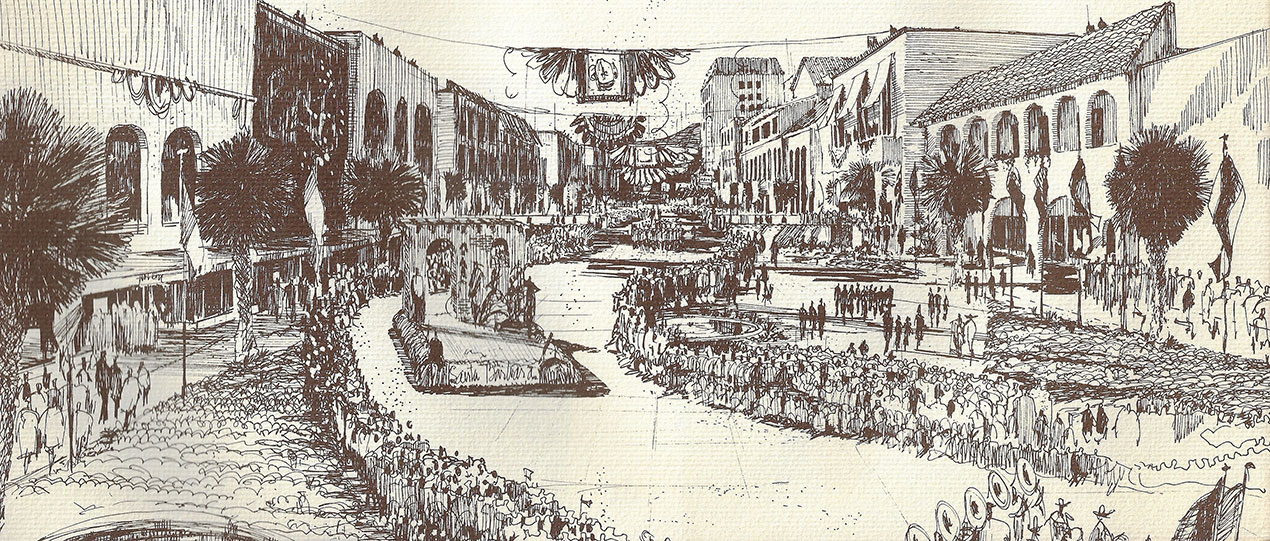
Paseo Estado: A downtown shopping area designed for the pedestrian.
THE PASEO — AN ESCAPE FROM THE AUTOMOBILE
There is a growing awareness that the automobile is getting out of hand; that its influence on the urban scene is becoming dictatorial rather than beneficent. It is the instrument whereby free rein was given to urban sprawl and, now that we have sprawled all over the landscape, it has become the indispensable element essential to holding the whole loosely knit package together. With the increase in population and prosperity, the automobile is demanding more and more land for its exclusive use.
In places like Los Angeles, it is demanding a lion’s share of the very air—polluting it and rendering it unfit to breathe. The quirk of nature that allows the automobile to steal the air in Los Angeles is called a “temperature inversion.” Santa Barbara has its own temperature inversion. All we need is a few more cars to attain the unhappy distinction of becoming more like Los Angeles.
— text and image from the 1964 General Plan for Santa Barbara
Over the past 20 years, Paris has undergone a major physical transformation, trading automotive arteries for bike lanes, adding green spaces and eliminating 50,000 parking spaces. Part of the payoff has been invisible — in the air itself.
Airparif, an independent group that tracks air quality for France’s capital region, reported that levels of fine particulate matter have decreased 55 percent, while nitrogen dioxide levels have fallen 50 percent. [Washington Post]
Thousands of people turned out on a sunny Saturday to celebrate the opening of San Francisco’s newest park, the 2-mile stretch of the Great Highway now dubbed Sunset Dunes. Runners, bicyclists with kids in tow, friends with coffees in hand and children on scooters all convened on the stretch of highway now permanently closed to cars. [SF Chronicle]
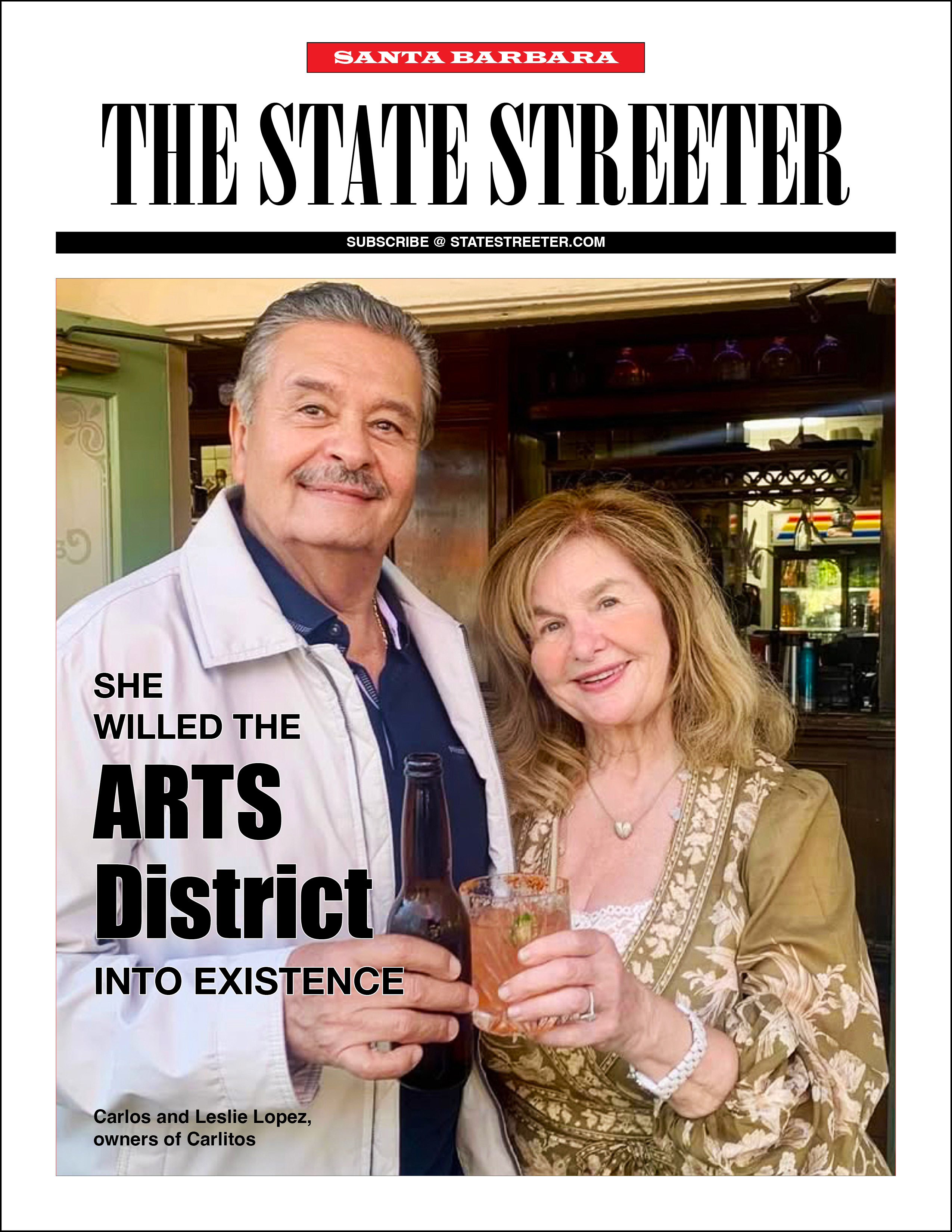
Although we were neighbors for many years, it took Covid to bring Leslie Lopez and me together as partners and friends in a common purpose. First we united to seek out strategies for survival in those difficult days, then later to question what happened to the vibrancy we had once known in our part of downtown — and what we could do to bring it back.
It was just two or three of us at first, with Caren Rager from the Granada Theater joining in. With helpful input and direction from publicist Jennifer Zacharias, and then from other friends and neighbors, we all came together to create Santa Barbara’s ARTS District.
Through many challenges and changes, with great ideas and help from so many, this organization evolved into being. While there is still much to be done, it has become a wonderful and ever-more impactful force for good in our community in the blocks along State Street from Figueroa to Sola, bringing attention to art of all kinds — art that spans both the realms of commerce and culture.
None of this would have been possible without the always bubbly, good-hearted and persistent encouragement that seemed to flow so naturally from Leslie — plus the occasional push and reminder it was time to get going already when the momentum sometimes slowed. Though sometimes differing on the details, we all shared a common vision of what that vibrancy would look like when restored. But there is one person who truly united us by always bringing the heart to all of our doings, and that was Leslie.
Sometimes pragmatic, sometimes canny, always warm and with kind intent, Leslie brought a caring emotional intelligence to whatever we were working on. Frequently she also generously provided the happy meeting place where many of those great ideas arose and took shape.
Her spirit continues to inspire us to carry on and further this work. To honor her contributions, and as a lasting legacy, we have made her and Carlitos a permanent founding member of the ARTS District and a permanent part of our story.
May her kind spirit and wise example live on.
Richard Yates is the owner, with Tina Takaya, of Opal restaurant, located just across State Street from Carlitos. He is also president of the ARTS District board of directors.
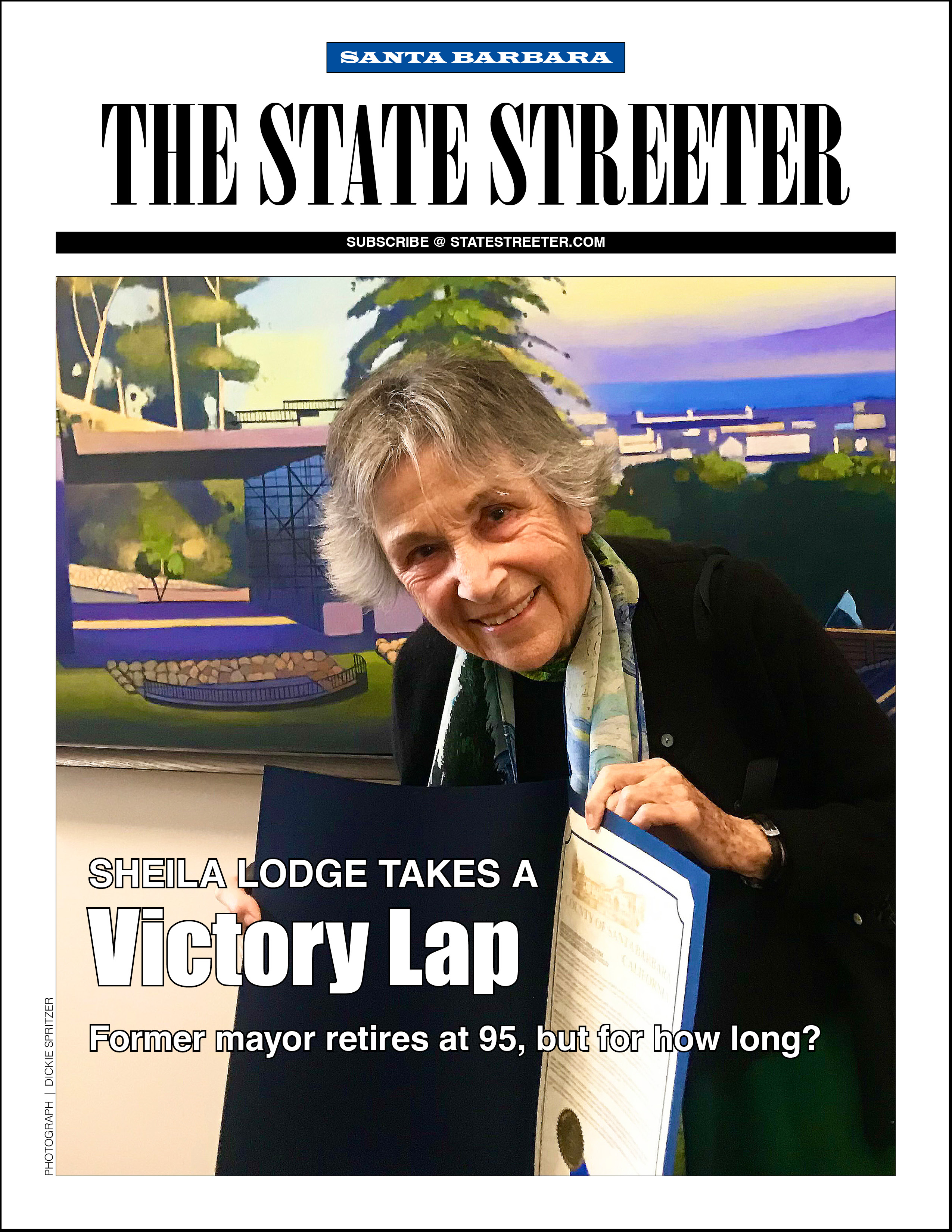
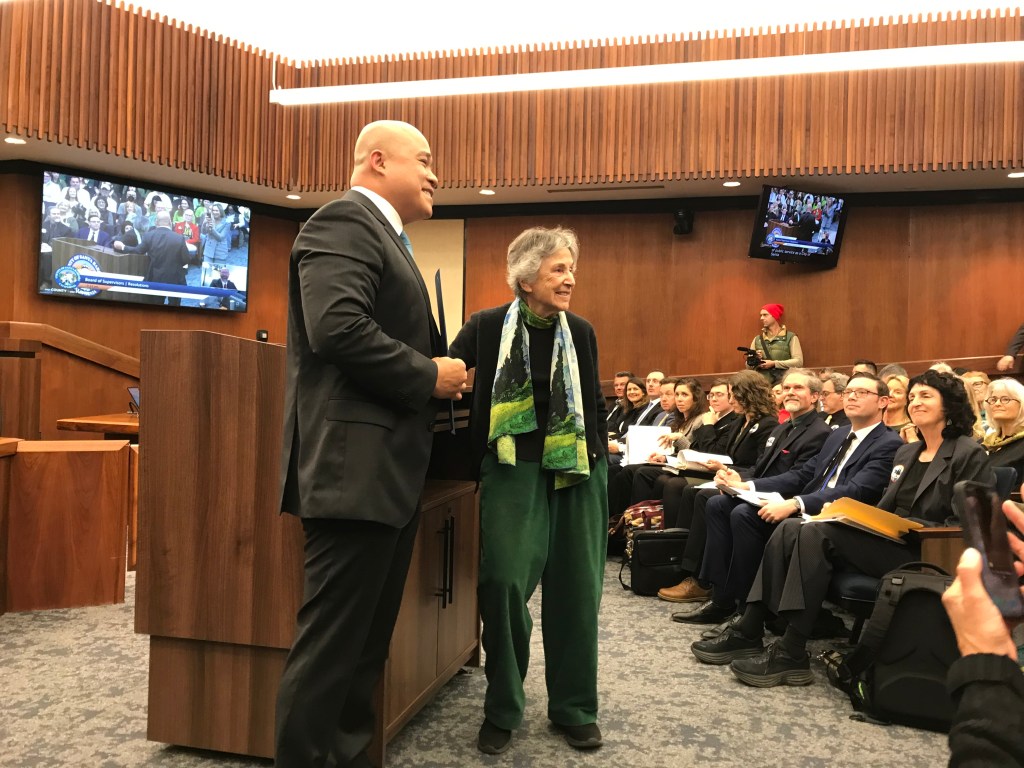
Sheila Lodge helped elect Supervisor Roy Lee, who honored her.
AS SHE WAS preparing to step down, way back in November 1993, after 12 years as mayor — the longest-serving mayor in Santa Barbara’s history — Sheila Lodge was serenaded by city staffers at a farewell lunch at El Paseo restaurant. To the tune of the folk classic “Hang Down Your Head, Tom Dooley,” they sang:
We’re going to miss you, Sheila. We’re going to miss your smile. We’re going to miss you, Sheila. Sure ’nuff, you’ve got some style.
Their expectations were upended three days later when, presiding over her final City Council meeting, she told a packed council chamber: “I love this city, and I’m not going away.” Barely a month later, in January 1994, she was seeking reappointment to the city Planning Commission, where she’d gotten her start in public service in 1973.
“I need to ease off of my involvement rather than go cold turkey,” she told the News-Press.
Soon Lodge changed her mind about rejoining the Planning Commission and instead became president of Planned Parenthood and head of Looking Good Santa Barbara, a group formed to improve the appearance and cleanliness of the city. It was not until 2008 that she was reappointed to the Planning Commission, where she went on to serve for 16 more years.
Lodge retired again in December 2024, and has been on something of a victory lap ever since. She was honored by the Board of Supervisors on February 25 and by the City Council on March 4. Another resolution is on the agenda for the April 3 Planning Commission meeting.
But this retirement may last no longer than the one three decades ago. After all, she’s only 95. And she’s said to be under consideration for a seat on the city’s Historic Landmarks Commission.
SOME PEOPLE COMPLAIN that no one goes to State Street anymore. They might want to stop by the Tuesday afternoon farmers market, between Cota and Canon Perdido, when the street comes alive with farmers offering their bounty, plus street musicians and strolling pedestrians. It happens again on Saturday mornings.
Many New Yorkers have come to avoid a stretch of Fifth Avenue in Midtown Manhattan that is perpetually choked by traffic and throngs of tourists clogging the sidewalk.
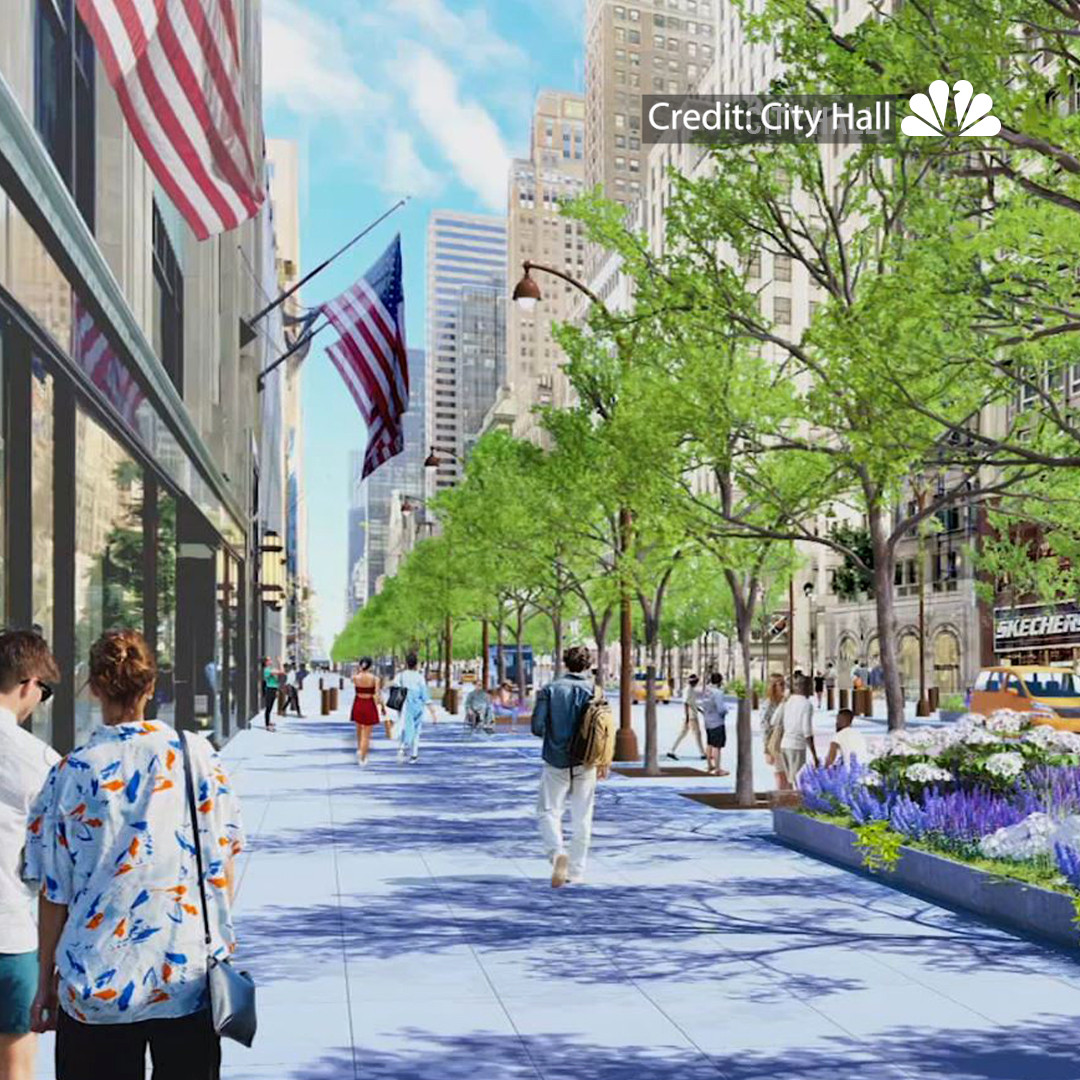
Now, there is a plan to restore the luster of the famed thoroughfare by revamping a central portion of it into a showcase boulevard for strolling and shopping, like the Champs-Élysées in Paris, Calle Serrano in Madrid or Bond Street in London. [Ed: Or as envisioned for State Street in Santa Barbara.]
The proposed redesign, which was announced Thursday, would span 20 blocks south of 60th Street, between Central Park and Bryant Park. It would significantly widen the sidewalks, add seating areas and plant more than 200 trees — while taking away two of the avenue’s five traffic lanes.
Some transportation experts and urban planners said that it was a good start toward addressing the need for more open space and better mobility, including more protected bike lanes, in the most congested part of the city. Kate Slevin, the executive vice president of the Regional Plan Association, which supports the Fifth Avenue redesign, said that “as the plan advances, we hope it can go even farther” and lead to “a longer-term vision of surrounding streets in Midtown.”
Even before the pandemic, retail sales along Fifth Avenue had lagged as many shoppers stayed away, said Madelyn Wils, the interim president of the Fifth Avenue Association, which runs the business improvement district.
“The sidewalks are crowded, there’s lots of obstructions and there’s no seating or greenery,” she said.
Ms. Wils said that remaking Fifth Avenue for pedestrians would increase foot traffic, which in turn would increase property values and retail sales and generate more tax revenue and fees for city coffers.
“It’s really about balancing the street and finally giving pedestrians the space they need on Fifth Avenue,” said the city’s Ya-Ting Liu.
THE SATURDAY MORNING FARMERS MARKET has a new home in downtown Santa Barbara on State and Carrillo Streets. Farmers report the move has gone smoothly so far. And a bustling crowd on a sunny Saturday morning suggests the new visibility is attracting more people.